MBTI Music Tester
Interactive Music · Max/MSP · 2024
A Max/MSP music-making interface that turns a listener's rhythm and sound choices into an MBTI-style result. Built in 2024, the project combines a step sequencer, synthesized instruments, and illustrated personality profiles.
Demo
The idea
MBTI was becoming a popular way for people around me to describe themselves. I wondered whether musical taste could be connected to those personality types. Instead of asking someone to answer a questionnaire, could they build a short piece of music and receive a result based on their choices?
That question became MBTI Music Tester. The interface lets the player choose rhythms and sounds for a kick, snare, hi-hat, and melody, then translates the resulting pattern into a four-letter type. The mapping is a set of subjective rules designed for the interaction, rather than a validated way to infer personality from music.
Making a pattern
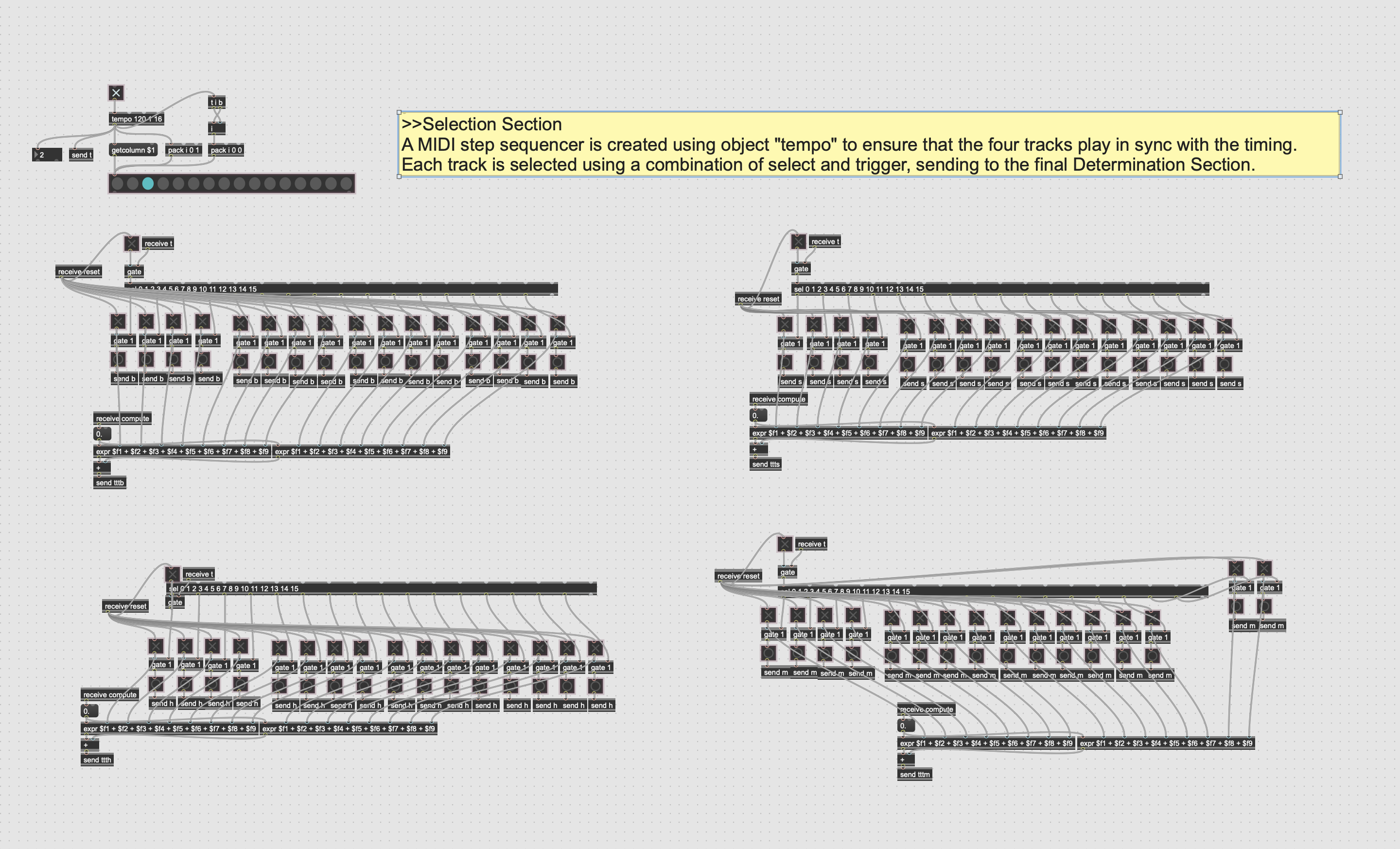
A shared step sequencer keeps the four tracks in sync. Players choose which steps trigger each instrument and adjust its sound and level while listening to the pattern. Once they are happy with the combination, a button calculates the result. Reset clears the choices for another attempt.
Synthesizing the sounds
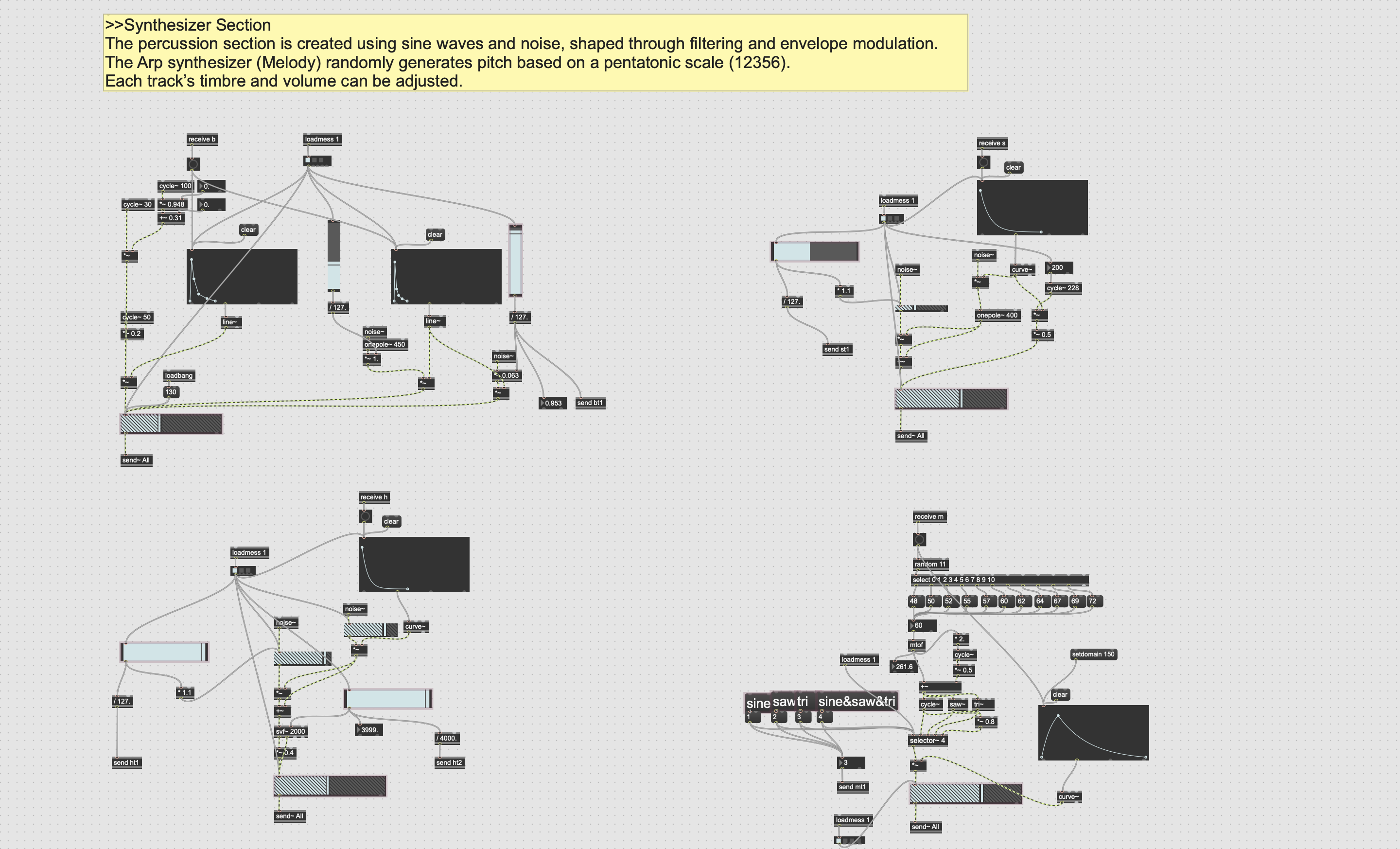
The percussion is synthesized from sine waves and noise, shaped with filters and envelopes. The melody draws random pitches from a pentatonic scale, with selectable oscillator waveforms. These controls let players change both the rhythmic pattern and its character before requesting a result.
From musical choices to a type
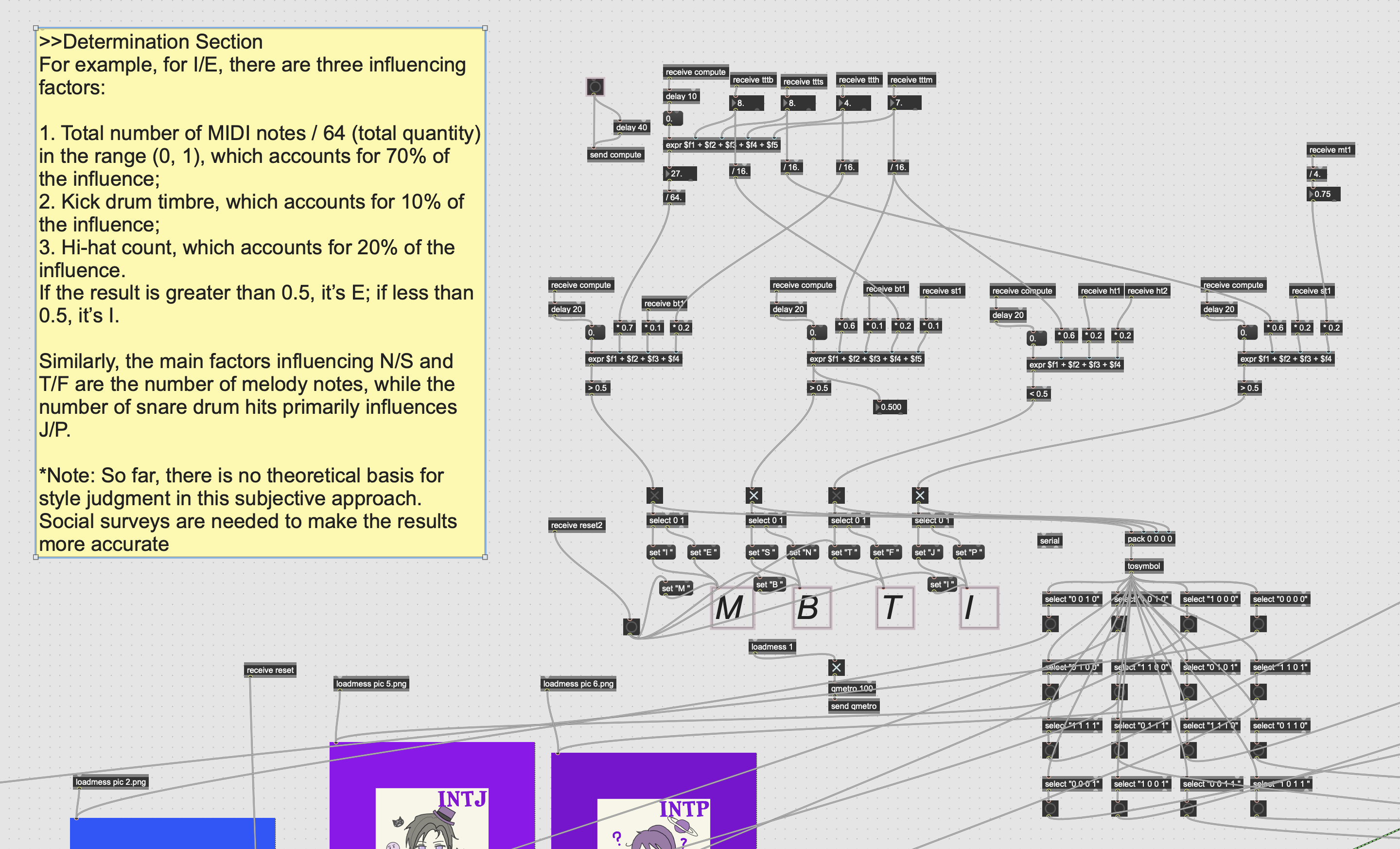
The patch counts the selected events and combines them with timbre settings to calculate each letter. For the I/E dimension, for example, total event density contributes 70% of the score, kick timbre contributes 10%, and hi-hat density contributes 20%. A threshold of 0.5 separates the two outcomes. Melody-note count is a main factor for N/S and T/F, while snare hits mainly influence J/P.
These weights make the result respond to the music the player creates. They were not fitted to survey data, so the result should be understood as part of the musical interaction rather than evidence of a relationship between taste and personality.
Showing the result
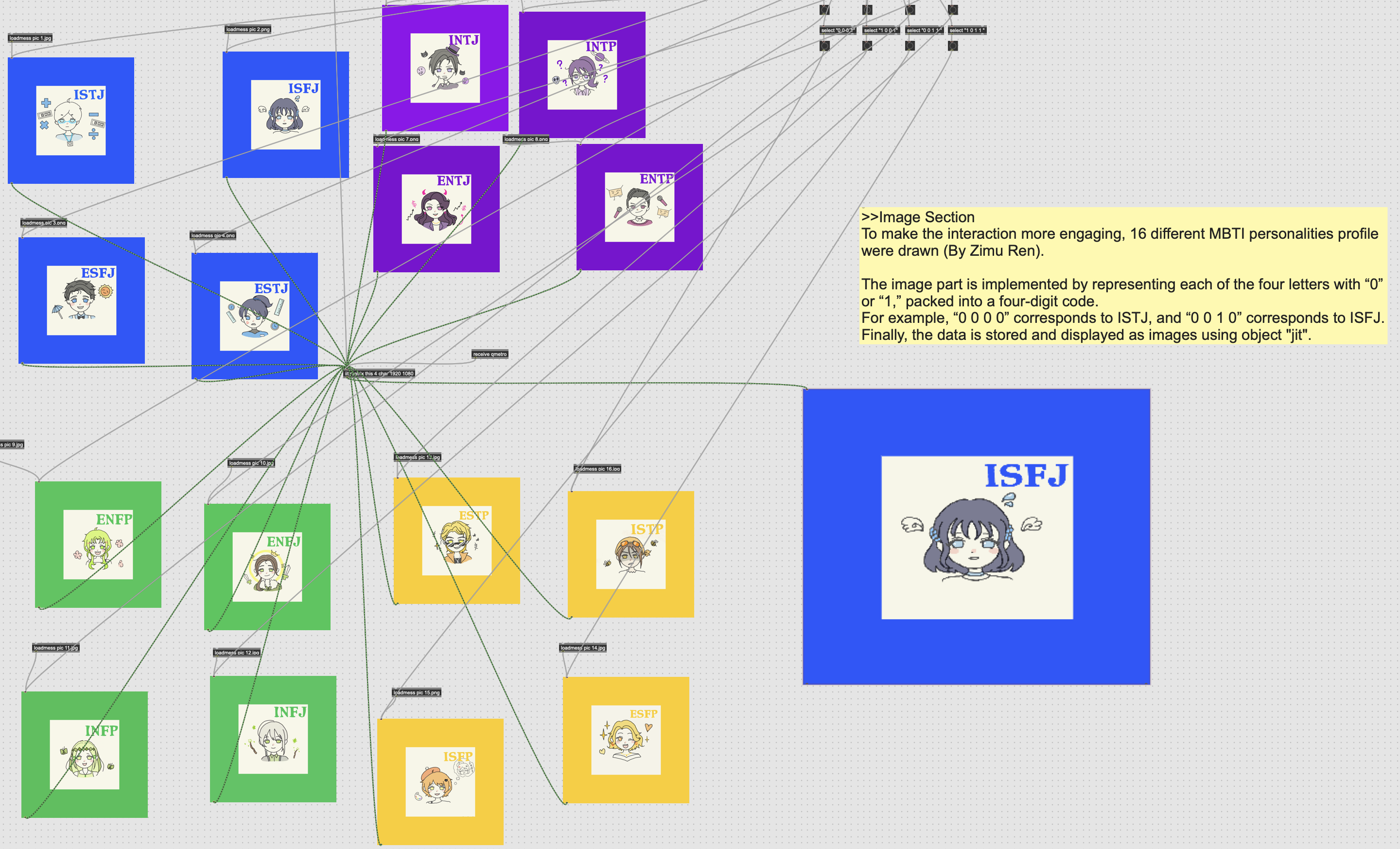
Each of the four letter choices is stored as a binary value. The resulting four-digit code selects one of 16 illustrated profiles, which is displayed through Jitter. For example, 0000 selects ISTJ and 0001 selects ISFJ. The illustrations were drawn by my friend Zimu Ren.